Blog: Narrative of Life of Frederick Douglas
Frederick Douglas was born into slavery and lived from 1818-1895. He was born in Maryland and died at age 77 in Washington D. C. Frederick Douglas was a slave from 1818-1838, and he taught himself to read and write even though it was illegal for a slave to be taught and it was punishable by death. He escaped to freedom in 1838 and in 1841 he attended an Anti slavery convention in Massachusetts. After he escaped he got married to a free American slave named Anna Murray who he met just before he ran away to freedom.
The book was written during his life as a slave about the terrors he suffered in slavery.
At the time the book was published in 1845, Frederick lectured about his life in slavery for the anti-slavery movement. Frederick also spent 2 years in Great Brittan and Ireland and gave several lectures there, mainly in churches and chapels.
During the pre-Civil War period, Frederick published a series of newspapers called the North Star. He also was outspoken about the lack of education for freed black children in New York and New England. Frederick was in his 40’s during the Civil War. He disapproved of John Brown’s plan for rebellion at Harper’s Ferry, but continued with the Abolitionist movement. Frederick met with President Lincoln in 1863 to discuss treatment of black soldiers. Six days after the war ended in 1865, Lincoln was shot and killed in Ford Theater. Frederick Douglass was there in the audience at Lincoln’s Memorial because Lincoln was his friend and helped all the slaves to freedom.
In the first chapter, his mother Harriet Talbot died when he was young and that is common for slaves; they lose their parents at a young age to death or slave trade. Parents were either sold or they died from a disease because he said that the slaves were sleeping in close quarters and it was easy to catch something. Separation of parent and child by selling to others was very common at this time and it was common that they never saw each other ever again. After Frederick’s mom died, most of his family was still alive but scattered on different plantations. He was lucky that he had one aunt that still lived on the plantation with him. Frederick was moved to a second plantation and he did mention that he had a cousin there to live with.
In the book it sounds like he lived in New England because he mentions at one point that the slaves went looking for oysters. At some points Frederick talks about a boat transporting him to a new plantation. He also talks about lumber that someone was going to use to make a boat and how he learned how to read and write the letters cut into the logs.
At the plantations there were a couple slaveholders that would keep an eye on the slaves and also whip them when they were bad. In the book, there was one really mean man and his name fitted his punishments. His name was Mr. Severe and he had a very colorful vocabulary, no heart visible in an X-ray, and a temper worse than a rhino’s. The slaves were happy when he died and he lived the way he died, saying bad words. There was a much nicer slaveholder at the plantation after him that had a less colorful vocabulary and a heart.
The slaves got a yearly allowance of clothes but the kids did not get clothes for a while. The slaves did not even have beds but they got blankets that were not very good looking. They also got food but they did not get a table to eat it on and it probably was not very good. Frederick did say that at his second master’s plantation the Colonel died there, then his son died some time after the father’s death, then his daughter died sometime after her brother’s death. The daughter was nice to Frederick so he sounded sad writing the book when he remembered it at the time he was writing the book. In the Afterword he is remembered in black history as a “culture hero”.
This was near the time Harriet Tubman and the Underground Railroad led slaves to freedom. Frederick Douglas probably sang this song “Follow the drinking gourd, follow the drinking gourd”. It really is a map to the Underground Railroad and the drinking gourd is the Big Dipper. At the time it was illegal for a slave to marry another or have a ceremony. The bride and groom had to hop on a broom and they were married. The slaves could not even go to church because they would pray to be released and the plantation owners would have no one to run the plantation for free.
The book was pretty good and when I read about Frederick Douglass on the Internet it sounded as if he was almost like Martin Luther King Jr. I think that after he ran away from slavery when he was 20 that he had a better life than a slave his same age. I am glad that he ran away and that he knew how to read and write. Otherwise this book would have never existed and I would not have known what slavery was like for a young person.
Saturday, February 16, 2008

Thursday, February 14, 2008
Malcolm X: Unfair Racism.
Malcolm Little was born into a period of great struggles for black people, in 1925, just a few years before the great depression. Malcolm had 7 siblings, and a caring mother and father. The family moved to Milwaukee, Wisconsin in 1926 and to Lansing Michigan shortly after. In 1931 Malcolm’s father was found dead after he got run over by a street car. After, Louise Little, Malcolm’s mother had a nervous breakdown and was later considered legally insane. Malcolm and his siblings went to separate foster homes. Malcolm graduated from junior high but decided not to continue his education after a teacher told him that he would never get the job he wanted, a lawyer, because of his race. Malcolm moved to New York in 1943. He found work as a shoeshine in Harlem. However, after a while in Harlem he turned to illegal activities such as drug dealing, gambling, and robbery. In 1946 Malcolm was arrested for stealing a watch. In court, he pleaded guilty and was sent to Charlestown State Prison. He found pleasure in reading books while in prison. In 1948 Malcolm was transferred to an experimental prison in Massachusetts. In 1952 he received parole and was released from prison. In 1952 he joined the nation of Islam. Soon after, he changed his surname to "X". Until Malcolm left the organization in 1964, Malcolm always preached the whites as "devils". in 1958 Malcolm got married to Betty X and later had 6 daughters. He founded his own organization called Muslim Mosque Inc. He completed his religious quest by making a pilgrimage to Mecca. Malcolm X was assonated on February 21, 1965 while he was delivering a speech in Manhattans Audubon Ballroom. His funeral was held on February 27, 1965.
Imagine being told that you would never become what you want, because of your skin color. Does it seem fair that fair skinned people have better chances of getting good jobs than black skinned people? I believe that racism is a major flaw in our society, especially a few decades ago, during Malcolm's time.
Think of all of the black people that were, and still are, being prosecuted just because of their skin color. I believe that black people are just as qualified, if not even more qualified, to do everything that white people do. Why are white people any "better" than black people? I believe that Malcolm suffered from a lot of racial judgment, from when he was one of the poorest kids in school, because his mother did not get paid as much as the other women, to when he got shot, just because he was giving a speech. I believe that he had a right to hate white people, he did not do any serious crime, he did not kill anyone, yet him and his followers were prosecuted, and even killed by white gangs and white individuals.
Towards the end of the book, Malcolm would be prepared for an attack at any minute. He kept a loaded gun in his possession. He even said To come right down to it, if I take the kind of things which I believe, then add to that the kind of temperament that I have, plus the one hundred per cent dedication I have to whatever I believe in- these are ingredients which make it just impossible for me to die of old age --The autobiography of Malcolm X. I believe that is not fair for any man to face because of his color of skin and his beliefs. Malcolm knew that he would be killed because of his black skin and his dedication to his beliefs, yet he did not give up. I think that level of determination proves that ones skin color does not make him who he is, he chooses who he wants to be. Skin color is simply what it seems, a color, not a bragging right.
You'll find very few people who feel like I feel that live long enough to get old. I'll tell you what I mean and why I say that. When I say by any means necessary, I mean it with all my heart, and my mind and my soul. But a black man should give his life to be free, but he should also be willing to take the life of those who want to take his. It's reciprocal. And when you think like that you don't live long... I believe that ones skin color goes only skin deep, it doesn't make you any better, I believe that what matters is how understanding and determined one is, and if he has great qualities, he will become a great man, white or black.
Imagine being told that you would never become what you want, because of your skin color. Does it seem fair that fair skinned people have better chances of getting good jobs than black skinned people? I believe that racism is a major flaw in our society, especially a few decades ago, during Malcolm's time.
Think of all of the black people that were, and still are, being prosecuted just because of their skin color. I believe that black people are just as qualified, if not even more qualified, to do everything that white people do. Why are white people any "better" than black people? I believe that Malcolm suffered from a lot of racial judgment, from when he was one of the poorest kids in school, because his mother did not get paid as much as the other women, to when he got shot, just because he was giving a speech. I believe that he had a right to hate white people, he did not do any serious crime, he did not kill anyone, yet him and his followers were prosecuted, and even killed by white gangs and white individuals.
Towards the end of the book, Malcolm would be prepared for an attack at any minute. He kept a loaded gun in his possession. He even said To come right down to it, if I take the kind of things which I believe, then add to that the kind of temperament that I have, plus the one hundred per cent dedication I have to whatever I believe in- these are ingredients which make it just impossible for me to die of old age --The autobiography of Malcolm X. I believe that is not fair for any man to face because of his color of skin and his beliefs. Malcolm knew that he would be killed because of his black skin and his dedication to his beliefs, yet he did not give up. I think that level of determination proves that ones skin color does not make him who he is, he chooses who he wants to be. Skin color is simply what it seems, a color, not a bragging right.
You'll find very few people who feel like I feel that live long enough to get old. I'll tell you what I mean and why I say that. When I say by any means necessary, I mean it with all my heart, and my mind and my soul. But a black man should give his life to be free, but he should also be willing to take the life of those who want to take his. It's reciprocal. And when you think like that you don't live long... I believe that ones skin color goes only skin deep, it doesn't make you any better, I believe that what matters is how understanding and determined one is, and if he has great qualities, he will become a great man, white or black.
Wednesday, February 13, 2008
malcom x blog
Malcom Little started out as a young, good boy. He always did the right thing. He was the president of his class and a very good student. He always listened to his parents and was a good kid. But later in life, his life took a bad turn. He went from a grade A student. To a hustling gangster. This turn, he proboably thought was good. but really, it was bad.
I have seen this in many people. their life is going in the right direction. then they start hanging out wit the wrong people. and make a turn for the worse. they will start doing the things that their friends are doing. wether it is just to fit in, be cool or because u got pressured in to doing it. it could be drugs, sex, or anything bad. i have seen a lot of people in my life that have done this. they will be going to church, caring abut school and getting good grades. they start hanging out with the wrong people and soon, you will stop seeing them at church. they will stop excelling at school. they will just care abut doing other things. it doesnt matter what it is. but mabye, they will relize that they are going in the wrong track, and will come back to being good. not everybody is the same. most people don't go off in the right track. but a lot of people do.
by dylan
I have seen this in many people. their life is going in the right direction. then they start hanging out wit the wrong people. and make a turn for the worse. they will start doing the things that their friends are doing. wether it is just to fit in, be cool or because u got pressured in to doing it. it could be drugs, sex, or anything bad. i have seen a lot of people in my life that have done this. they will be going to church, caring abut school and getting good grades. they start hanging out with the wrong people and soon, you will stop seeing them at church. they will stop excelling at school. they will just care abut doing other things. it doesnt matter what it is. but mabye, they will relize that they are going in the wrong track, and will come back to being good. not everybody is the same. most people don't go off in the right track. but a lot of people do.
by dylan
in the time of malcolm X
An attempted black right movement had started out from his father, Earl Little and Marcus Garvey. Marcus Garvey was the founder of the Universal Negro Improvement Association or U.N.I.A in which Malcolm’s was a big part of and he ran the Omaha chapter. This organization’s main purpose was to bring about a black rights movement to that there for the rights that they could have the freedoms that the non colored white people had such as sitting in the front of the bus going to the same schools and therefore that black people could have the same respect and dignity as the other people. Malcolm also contributed to this by doing speeches setting up rallies doing protests and occasionally violent acts to show that they were serious. Malcolm X started a group after he had become a Muslim he stated a group called the black Muslims in which he when to different places trying to get the best care for the black people in the area. Authorities in those areas knew about the Black Muslims and heard rumors that they hated white people and that they were trained in the deadliest of the martial arts, but this was not true the Black Muslims were a peaceful group that did know the martial arts but did not use them they were just there to take good care of the black population.
--by ilind farris
--by ilind farris
Monday, February 11, 2008
The Backgrounds of Malcolm X and Martin Luther King, Jr.
On May 19, 4 years before the Great Depression began, Malcolm Little was born to young, African-American parents, Earl and Louise Little in Omaha, Nebraska. He grew up in a family of 7 children with a father who was a minister and a big part of the Universal Negro Improvement Association (U.N.I.A.) and an educated mother who had come from the British Island of Grenada. When Malcolm was 4, his family moved to a farmhouse in Lansing, Michigan. However, whites who were opposed to having black neighbors burnt down the house on a cold, November night. The family moved again, only to be met with similar challenges. In 1929, Earl Little began to fear for his family's safety and moved again to the outskirts of Lansing. As the son of the head of a U.N.I.A. chapter, Malcolm grew up listening to his father speaking at many public functions about the problems that faced black people who lived in America.
However, when Malcolm was 6 years old, his father was crushed by a trolley and killed. Around this time, Malcolm started school in a mainly white elementary school. He struggled through this time of his life, as did his mother and the rest of America. His mother, as smart as she was, could not keep a job and support her family. Malcolm and the rest of the Little children were sent to different foster homes in Michigan.
As a young teenager, Malcolm began to have troubles in school, and was transferred to a county juvenile home 12 miles from his mother's home. At the juvenile home, Malcolm was pushed to get good grades, and succeeded. However, one time one of his highly respected asked him what he wanted to do with his life. Malcolm responded by saying that he wanted to be a lawyer. His teaches seemed displeased, and said,
"We all here like you, you know that. But you've got to be realistic about being a nigger. A lawyer- that's no realistic goal for a nigger. You need to think about something you can be. You're good with your hands. Why don't you plan on carpentry?"
This was a turning point in Malcolm's life. To make a change in his life, he moved to boston in 1941 to live with his half-sister, Ella. Boston was a completely different city than Lansing, with many more black people. In this town, Malcolm began to hang out with different people, an they influenced him greatly. After awhile, he moved to Harlem in search of more respect as a black man. The new Malcolm believed that this respect would be found only in a black community. He began to steal things, and he was eventually caught. He was sentenced to a State Prison for eight to ten years. While in prison, he received letterd from his brothers and sisters, especially from his brother, Renigald, who was a minister in the Nation of Islam. After talking and corresponding with several Islamists, Malcolm decided to convert to the religion in 1947.
Five years later, Malcolm was released from prison and moved to Detroit. A month later, he heard the leader of the Nation of Islam, Elijah Muhammad, speak. Afterwards, he gave up his English last name of Little X, to symbolize his African roots, and became a minister in a New York temple. There, Malcolm used his knowledge from his days in Harlem to spread the religion of Islam. He met a young, beautiful, black woman called Betty and they married in January, 1958. Ten months after, their first daughter, Attallah, was born. Her sister Qubilah followed two years later. They also had a third daughter after another two years named Ilysah. During this time, the rapidly-growing Nation of Islam was being represented more and more in America by a militant Malcolm. He once proclaimed at a public speech, " Our enemy is the white man! . . .Oh, yes, that devil is our enemy."
In the late 1950s, while many black people in the North were speaking of the strength of Malcolm X and the Nation of Islam, the people in the South were talking about Martin Luther King, Jr., and the strength of his nonviolent methods to fight racial discrimination. The F.B.I. began to take tabs on Malcolm, especially after he spoke with the leader of Cuba, Fidel Castro. Elijah Muhammad and Malcolm began to not quite see eye-to-eye. After Malcolm publicly commented on President Kennedy's assassination against the wishes of the Nation of Islam, he split from the Nation in 1964. He soon formed a new organization, Muslim Mosque, Inc., and met Martin Luther King. In order to fulfill his religious quest, he completed a pilgrimage to Mecca and returned with another new name, and many new ideas. The same year, his fourth daughter, Gamilah, was born.
Sadly, Malcolm X was assassinated on February 21st, 1965 when he was delivering a speech in Harlem's Audobon Ballroom. He lived to be the mere age of 40. That fall after his death, his twin daughters (numbers five and six) were born. More than a year after Malcolm's assassination, Talmadge Hayer, Norman 3X Butler, and Thomas 15X Johnson were convicted of his murder, and sentenced to life imprisonment.
However, Malcolm's goal and dream of racial equality was not his alone. Another man that was born 4 years after him, and assassinated 3 years after him, was a civil rights activist in the South, while Malcolm was the activist of the North. This man's name was Dr. Martin Luther King, Jr. While Malcolm X in the northern United States was preaching the religion of Islam and for blacks to become equal "by any means necessary", Martin was being influenced by men such as Mohandas Gandhi and Henry David Thoreau, and preaching civil disobedience and non-violence. Both of these very famous men had very different approaches to the same goal due to their early influences and experiences.
As mentioned, one of Malcolm's early traumatic memories was having his family home burnt down. His father was killed, possibly by the Ku Klux Klan. He watched his mother struggle to feed all of her children during the Great Depression, and eventually she had a mental breakdown. As a young, bright student, Malcolm was taken away from his mother and suffered through integrated schooling. Once a respected teacher told him he could not be a lawyer and crushed his dreams. Subsequently, he dropped out of school, became involved with crime, and ended up in prison. No wonder Malcolm once said that whites were "agents of the devil"! He grew up in an atmosphere of violence, and most of that was due to white men.
Martin Luther King, however, was raised in the exact opposite environment, where dreams and love existed in his middle-class family with loving parents who both had professions. They taught him strong values that nurtured his sense of self-worth. Martin skipped two grades and graduated high school at the age of 15. With an A average, he entered and Ivy League college and quickly graduated. A few years after, he became a minister in the Baptist religion, and moved on to being a black civil rights activist that will be famous for centuries.
Can you see how these two men's histories are so different? They both grew up in very different environments, and I think this significantly affected their strategies of how to win equality between races. Because Malcolm grew up with so much violence and fighting in his life, I believe that helps to explain why he believed the only way to gain equality was by "any means necessary", including violence. He was taught of as an extremist and once said he believed in "black supremacy". Martin, however, grew up knowing love and peace, and believed in the Lord and Savior, Jesus Christ. He was taught by a supportive family that there are other other ways to solve things, as long as you use patience. These two great leaders of the civil rights movement both had very different tactics that seem to be influenced by their opposite backgrounds.
Sunday, February 10, 2008
Malcolm X By Any Means Necessary
In Malclom X By Any Means Necessary, by Walter Dean Myers, we are shown how Malcolm Little grew up and became Malcolm X. On May 19, 1925, Malcolm Little was born in Omaha, Nebraska. Malcolm’s father, Earl Little, wanted to “help his people gain their independence, and to help African-Americans everywhere to reach their full potential.” Influenced by the ideas of Marcus Garvey, a black leader, Earl Little fought for the rights of African-Americans. By speaking out, Earl Little spread his message. Because he spoke out about his beliefs, he was always threatened by racists and others who disagreed. When Malcolm was four, the Little family moved into Lansing, Michigan. But whites there did not want him and his family in their neighborhood. They took this to court, but when Earl Little decided to stay in the house, the house was set on fire and burnt down. Because of this, they moved into East Lansing, Michigan. But he was still getting threats and moved again. Then on September 28, 1931, Malcolm’s father died. He had been run over by a trolley. The conductor claimed to not have seen him, but Malcolm’s mother, Louise, believed he was killed by whites who did not want him to spread his beliefs about blacks.
America was in the middle of a depression when Malcolm’s father had died. Jobs were scarce and single mother Louise was having a very hard time providing for her family. Malcolm had to face poverty at the young age of six. He was teased at school because of his old clothes. He would go hungry some days because they had no money. Malcolm was good in school, and realized that he was bright. But at home, things were not going well. All the stress was taking a toll on his mother. She began to cry for no reason or talk to herself. When social workers came to their home, they found his mother to be an “unfit mother.” She was taken away from her children and they were put into foster homes. Malcolm was still doing very well in school. He was at the top of his classes and was elected as class president in the 8th grade. But one day, his teacher asked what Malcolm wanted to be when he grew up. He told his teacher that he wanted to be a lawyer. Instead of supporting this idea, his teacher said, “. . . you’ve got to be realistic about being a nigger. A lawyer – that’s no realistic goal for a nigger.” Although Malcolm knew that blacks were not expected to succeed, he thought that if he could work hard and get good grades that he could still make it. But talking with his teacher changed his mind. He went to live with his half-sister, Ella, in Boston.
Malcolm loved the excitement in Boston, and this is where he found himself a new image. With the help of his new friend, Shorty, he got his first zoot suit and a conk. Since he had dropped out of school, he was able to have a job as a shoeshine boy, a clerk in a drugstore, a busboy, and, with the help of one of Ella’s friend, a kitchen helper on the railroad. Because of Malcolm’s kitchen helper job, he was able to see different cities, including Harlem. Malcolm felt at home in Harlem’s black community. It was in Harlem where he felt that he could earn respect. But he started to use drugs. When his drugs got him into trouble with New York gangs, he moved back to Boston. There, he and a couple of his friends started to rob houses. But they were caught and Malcolm was sentenced to eight to ten years of hard labor. He was put in the Charlestown State Prison. He learned about an experimental prison reform plan that was being conducted at an institution in Norfolk, Massachusetts. He was accepted and found that Norfolk had an excellent library. From letters that he received from his relatives, he found out about the Nation of Islam.
The Nation of Islam was not just a religion. It was a movement. At 23 years old, Malcolm Little converted and wrote a letter to the head of the Nation of Islam, Elijah Muhammad. In Elijah’s reply, Malcolm was told not to think of himself as a criminal, but to think of the whites who had forced you into the acts you have committed as the criminals. When Malcolm was released from prison in 1952, he found a job at a furniture store, lived with his brother, Wilfred, in Detroit, and joined Temple Number One in Detroit. In Chicago, Malcolm saw Elijah Muhammad for the first time. After the meeting, Elijah invited him and other members to his home. They decided to try to recruit the young people in the area. After attending meeting and listening to the teachings of ministers, Malcolm Little fully understood the beliefs of the Nation of Islam. He had full membership and now, he had the right to drop his “slave name” and assume the last name of “X.” The “X” stood for his unknown, lost African name. This is how Malcolm Little became Malcolm X.
In 1954 Malcolm becomes the minister of New York Temple Number Seven and, four years later, marries Sister Betty X. Thanks to Malcolm, the Nation of Islam was growing rapidly. However, the growth proved to be too much for the structure to handle. Conflicts between Elijah Muhammad and Malcolm arose. So in 1964, Malcolm announced his split from the Nation of Islam.
After making the sacred hajj, Malcolm changed his message, he was willing to work with all races, as long as they were sincere in their efforts to help African-Americans gain freedom.
But during one of Malcolm’s speeches, in February of 1965, he was shot. A year later, it was found that Talmadge Hayer, Norman 3X Butler, and Thomas 15X Johnson had assassinated Malcolm X.
My Response:
Although I believe that Malcolm X was right, and African-Americans should be given their freedom, I do not agree with his methods. I can see it is hard to just stand by and watch “their women and children being beaten and killed,” but if you use violence to end violence, nothing gets solved. I understand that it is hard to let someone push you down without kicking him back, but if you do the same thing that he is doing, you’re no better of a person. I think if Malcolm X had followed the kindergarten rule, two wrongs don’t make a right, people would have been more supportive and his message would have gotten through a little better. Martin Luther King Jr. used tactics that created “enormous sympathy for the black cause throughout the world,” and this increased “moral pressure on American legislators to pass and enforce the new civil rights laws.” I know that Martin Luther King Jr. and Malcolm X had the same goal. Both wanted to give their people the rights they deserved. However, their ideas and methods were different. I cannot say that I completely agree with Malcolm’s ideas, but I do believe that American would not be what it is today without Malcolm X.
America was in the middle of a depression when Malcolm’s father had died. Jobs were scarce and single mother Louise was having a very hard time providing for her family. Malcolm had to face poverty at the young age of six. He was teased at school because of his old clothes. He would go hungry some days because they had no money. Malcolm was good in school, and realized that he was bright. But at home, things were not going well. All the stress was taking a toll on his mother. She began to cry for no reason or talk to herself. When social workers came to their home, they found his mother to be an “unfit mother.” She was taken away from her children and they were put into foster homes. Malcolm was still doing very well in school. He was at the top of his classes and was elected as class president in the 8th grade. But one day, his teacher asked what Malcolm wanted to be when he grew up. He told his teacher that he wanted to be a lawyer. Instead of supporting this idea, his teacher said, “. . . you’ve got to be realistic about being a nigger. A lawyer – that’s no realistic goal for a nigger.” Although Malcolm knew that blacks were not expected to succeed, he thought that if he could work hard and get good grades that he could still make it. But talking with his teacher changed his mind. He went to live with his half-sister, Ella, in Boston.
Malcolm loved the excitement in Boston, and this is where he found himself a new image. With the help of his new friend, Shorty, he got his first zoot suit and a conk. Since he had dropped out of school, he was able to have a job as a shoeshine boy, a clerk in a drugstore, a busboy, and, with the help of one of Ella’s friend, a kitchen helper on the railroad. Because of Malcolm’s kitchen helper job, he was able to see different cities, including Harlem. Malcolm felt at home in Harlem’s black community. It was in Harlem where he felt that he could earn respect. But he started to use drugs. When his drugs got him into trouble with New York gangs, he moved back to Boston. There, he and a couple of his friends started to rob houses. But they were caught and Malcolm was sentenced to eight to ten years of hard labor. He was put in the Charlestown State Prison. He learned about an experimental prison reform plan that was being conducted at an institution in Norfolk, Massachusetts. He was accepted and found that Norfolk had an excellent library. From letters that he received from his relatives, he found out about the Nation of Islam.
The Nation of Islam was not just a religion. It was a movement. At 23 years old, Malcolm Little converted and wrote a letter to the head of the Nation of Islam, Elijah Muhammad. In Elijah’s reply, Malcolm was told not to think of himself as a criminal, but to think of the whites who had forced you into the acts you have committed as the criminals. When Malcolm was released from prison in 1952, he found a job at a furniture store, lived with his brother, Wilfred, in Detroit, and joined Temple Number One in Detroit. In Chicago, Malcolm saw Elijah Muhammad for the first time. After the meeting, Elijah invited him and other members to his home. They decided to try to recruit the young people in the area. After attending meeting and listening to the teachings of ministers, Malcolm Little fully understood the beliefs of the Nation of Islam. He had full membership and now, he had the right to drop his “slave name” and assume the last name of “X.” The “X” stood for his unknown, lost African name. This is how Malcolm Little became Malcolm X.
In 1954 Malcolm becomes the minister of New York Temple Number Seven and, four years later, marries Sister Betty X. Thanks to Malcolm, the Nation of Islam was growing rapidly. However, the growth proved to be too much for the structure to handle. Conflicts between Elijah Muhammad and Malcolm arose. So in 1964, Malcolm announced his split from the Nation of Islam.
After making the sacred hajj, Malcolm changed his message, he was willing to work with all races, as long as they were sincere in their efforts to help African-Americans gain freedom.
But during one of Malcolm’s speeches, in February of 1965, he was shot. A year later, it was found that Talmadge Hayer, Norman 3X Butler, and Thomas 15X Johnson had assassinated Malcolm X.
My Response:
Although I believe that Malcolm X was right, and African-Americans should be given their freedom, I do not agree with his methods. I can see it is hard to just stand by and watch “their women and children being beaten and killed,” but if you use violence to end violence, nothing gets solved. I understand that it is hard to let someone push you down without kicking him back, but if you do the same thing that he is doing, you’re no better of a person. I think if Malcolm X had followed the kindergarten rule, two wrongs don’t make a right, people would have been more supportive and his message would have gotten through a little better. Martin Luther King Jr. used tactics that created “enormous sympathy for the black cause throughout the world,” and this increased “moral pressure on American legislators to pass and enforce the new civil rights laws.” I know that Martin Luther King Jr. and Malcolm X had the same goal. Both wanted to give their people the rights they deserved. However, their ideas and methods were different. I cannot say that I completely agree with Malcolm’s ideas, but I do believe that American would not be what it is today without Malcolm X.
Friday, February 8, 2008
Malcolm X: By Any Means Necessary
Malcolm X
By Any Means Necessary
By Any Means Necessary
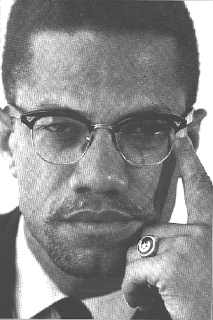
Malcolm Little was born on May 19, 1925 to Earl and Louise Little. He had many other siblings. On September 28, 1931, Malcolm received the news that his father had died. He was six years old at the time. After his father’s death, things started to go downhill. Malcolm started to feel insecure, and his mother was struggling to make money to buy the food the family needed. His mother was hardly ever home because she was too busy working or looking for work. There was no money for clothing, and Malcolm had to wear what was handed down to him by his older brothers. Then one day, Malcolm was caught stealing, and one of the neighbors reported it to the welfare investigator. The welfare investigator then questioned Malcolm’s mother, and she began to cry. Louise Little then began to sit for long periods of time without speaking. She acted as if she suddenly forgot to do things she always had done before around the house. She would ignore the children and began talking to no one in particular. She would often cry softly to herself for no reason. Soon her condition worsened, and Malcolm and some of his siblings were placed in separate homes. Malcolm was placed in a home of a black family named the Goannas. He was sad that he had been separated from his family. Malcolm was transferred from the Pleasant Grove School to West Junior High School. He began to have troubles in WJH, and one day, he put a thumbtack under the teacher’s chair and was expelled. He simply thought he wouldn’t attend school after that, but he was then forced into a reform school, which was run by the Swerlein family in Mason.
During this time in his life, Malcolm met Ella, his half sister. She invited Malcolm to Boston. Malcolm wasn’t used to cities, but he was fascinated by the pace, the music and the fast life. He then moved to the city of Boston, where there was a history of black populations and a history of civil rights. In 1943, he moved to New York City. He worked for the New Haven Railroad, and he also worked as a shoe shiner at a Lindy Hop nightclub. After some time in Harlem, he became involved in drug dealing, gambling, robbery, etc. His friends started to call him "Detroit Red.” He was later arrested for robbery and spent six years in prison.
While Malcolm was in prison, his brother Reginald wrote letters describing his experience with the Nation Of Islan, and Malcolm decided to convert.
In 1952, Malcolm was released from prison, and he went to meet Elijah Muhammad in Chicago. Soon after his meeting with Elijah Muhammad, he changed his last name, Little, to X. The X symbolizes the rejection of their slave names and the disappearance of the “inherited African” name.
In 1958, Malcolm married Betty X in Lansing, Michigan, and had six daughters. Malcolm soon started traveling and preaching about segregation. He, like Martin Luther King, Jr., did not agree with the dividing of blacks and whites. He forced equality upon the people he preached to, literally. He wanted people to get freedom… “by any means necessary.” On Feburary21,1965, Malcolm had just begun giving a speech when a disturbance broke out in the crowd. As Malcolm and his bodyguards moved to quiet the disturbance, a man rushed forward and shot Malcolm in the chest. Two other men charged the stage and fired at Malcolm. Malcolm was shot 16 times and was pronounced dead on arrival at New York's CNew York's Columbia Preysbyterian Hostpital.
My Response:
I think that it’s just crazy how people can get so caught up in hating someone just because what that person says is true. Malcolm X wanted a change. He didn’t like the separation of blacks and whites so he preached about it, and what came next? He got shot. How ironic. Martin Luther King, Jr. did the same thing, and he also got shot. I think its kind of weird. I also think it’s pretty pathetic that people would just shoot another person just because they don’t believe in what the other person believes in. I think Malcolm X preached for the right thing. I mean who ever heard of separating people just because of their color? That’s like separating oranges from oranges. Everyone is the same, or should I say that everyone is equal?
Isn’t America supposed to be about freedom of speech and taking a stand when you think something isn’t right? What’s up with that?
Speaking of freedom of speech and expression, at times, I see our society as a hypocritical one. We say things like you can dress however you want to dress, and then some smart kid comes along and asks, “What is that you’re wearing?” “Shouldn’t you be dressed like us?” “Shouldn’t you conform?” I mean what the heck?! Then the very next day, that smart kid comes to school with the outfit you were wearing yesterday, and you’re wearing what he wore yesterday. The smart kid says, “What is that you’re wearing?” Other times, it’s like a person tells you to be quiet, and then in the next five minutes, that person who told you to be quiet is screaming at the top of their lungs.
I also think that Malcolm shouldn’t have forced a change upon people. Although sometimes it’s good to get people’s attention and make them realize that these types of things are happening, I don’t think it should have been violently done. Using force to change people will get them angry because who would want someone coming up to them and violently forcing change upon them? I know I wouldn’t. Martin Luther King, Jr. spread his ideas peacefully and without force, and for that, we respect him and have a holiday devoted to him. I think his message got around way more strongly than Malcolm’s ever did. Martin Luther King, Jr. said, “While we did not always see eye to eye on methods to solve the race problem, I always had a deep affection for Malcolm and felt that he had a great ability to put his finger on the existence and the root of the problem. He was an eloquent spokesman for his point of view and no one can honestly doubt that Malcolm had a great concern for the problems we face as a race.” And Elija Muhammad said, “Malcolm X got just what he preached."
--Lasie Eto
Subscribe to:
Posts (Atom)